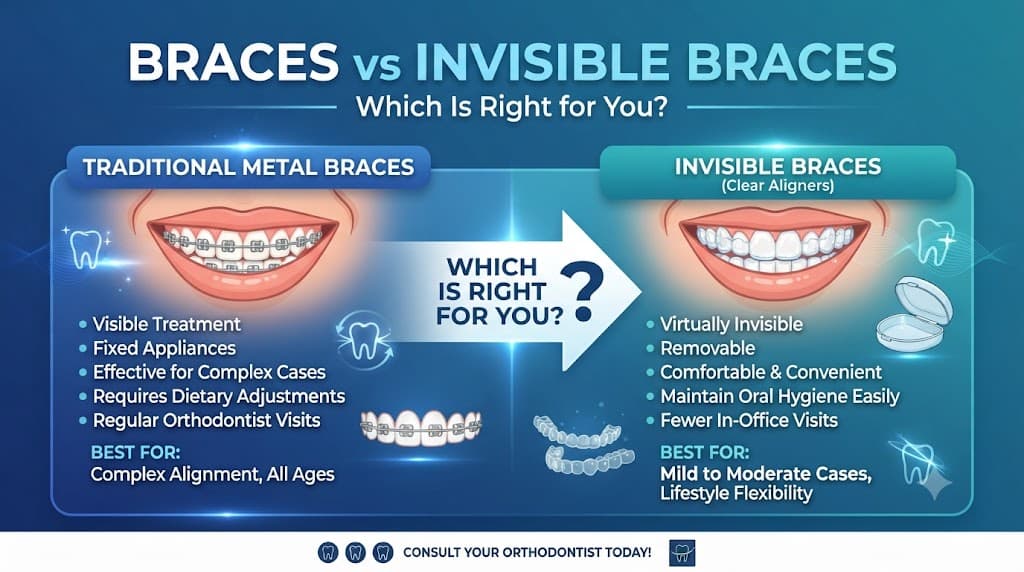
Braces vs Invisible Braces: Which Is Right for You?
A straight, healthy smile can improve both your oral health and confidence. Today, patients have more orthodontic options than ever, with traditional braces and invisible braces being two of the most popular choices. But which one is right for you? The answer depends on your dental needs, lifestyle, budget, and treatment goals.
What Are Traditional Braces?
Traditional braces use metal brackets attached to the teeth and connected with wires. Over time, the orthodontist gradually adjusts the wires to move the teeth into their correct positions.
Modern braces can effectively treat various orthodontic problems, including:
- Crooked teeth
- Crowded teeth
- Gaps between teeth
- Bite problems
- Complex tooth movements
One of the biggest advantages of traditional braces is their ability to manage more complex orthodontic cases effectively.
What Are Invisible Braces?
Invisible braces, also known as clear aligners, are transparent, removable trays designed to gradually move your teeth into the desired position. These aligners are custom-made and replaced periodically during treatment.
Clear aligners are increasingly popular among adults and teenagers because they are nearly invisible and offer greater flexibility.
Benefits of invisible braces include:
- Almost invisible appearance
- Removable while eating
- Easier brushing and flossing
- Comfortable and smooth design
- Suitable for busy lifestyles
However, invisible braces may not be suitable for all dental problems. A professional dental consultation is important to determine the most appropriate treatment.
Braces vs Invisible Braces: Key Differences
| Feature | Traditional Braces | Invisible Braces |
|---|---|---|
| Appearance | Visible metal brackets and wires | Nearly invisible |
| Removable | No | Yes |
| Cleaning | Requires extra care | Generally easier |
| Complex Cases | Can treat many complex cases | Suitability depends on the case |
Which Option Should You Choose?
There is no single treatment that is best for everyone. Your dentist or orthodontist will evaluate your teeth, bite, oral health, and treatment goals before recommending the most suitable option.
If you are concerned about aesthetics and prefer a removable option, invisible braces may be suitable. If your case requires complex tooth movement, traditional braces may be recommended.
Final Thoughts
Both traditional braces and invisible braces can help you achieve a healthier and more attractive smile. The right choice depends on your individual dental condition, lifestyle, and expectations.
If you are considering orthodontic treatment, consult a qualified dental professional to determine whether traditional braces or invisible braces are the best option for your smile.